
 By
By Higher Education · Artificial Intelligence · Ed Tech
Khan Academy, the TED Conference, and testing giant ETS are launching a new online institution that bets on competency-based learning—not seat time—as the future of higher education in the age of generative AI.
Why this matters for the future of college
Generative AI is fundamentally disrupting how colleges teach and evaluate students—yet there is still little consensus on what a degree should actually signify. The Khan TED Institute enters that vacuum with a bold, low-cost alternative designed specifically for the AI era.
What is the Khan TED Institute?
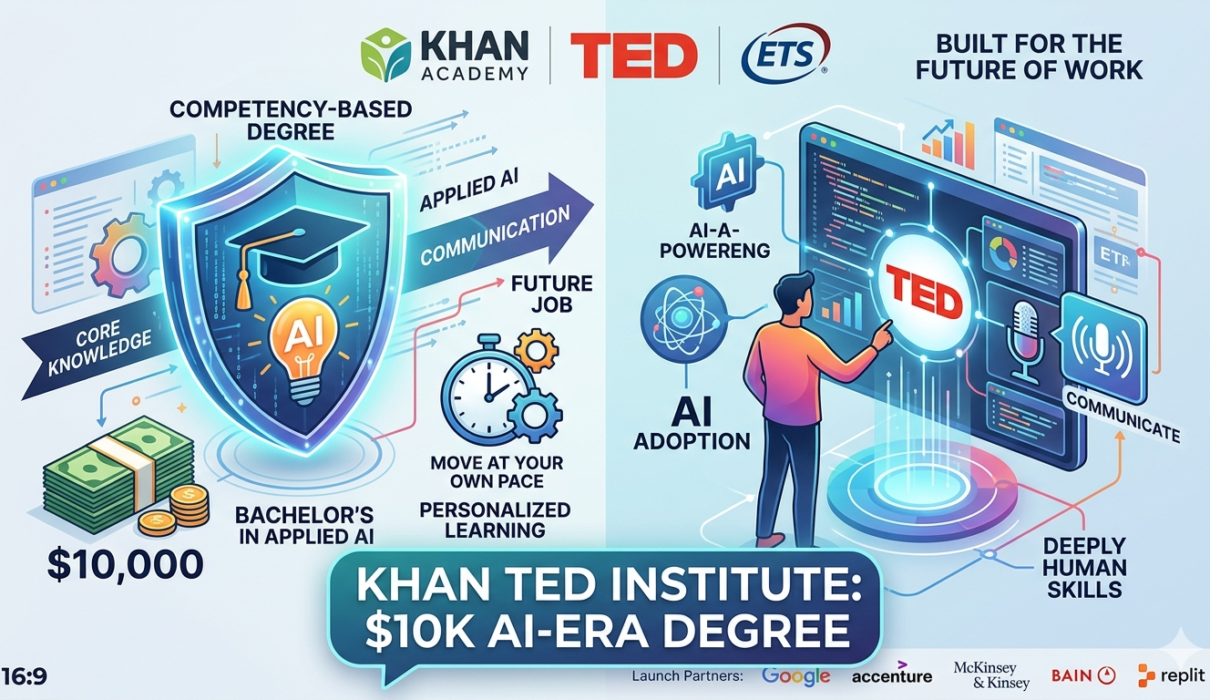
Announced at the TED Conference on Tuesday, the Khan TED Institute is a nonprofit collaboration between Khan Academy, TED, and ETS. The interactive online program is designed to train students for AI-era jobs while placing equal emphasis on deeply human skills such as communication, critical thinking, and professional judgment.
Here are the key details:
- Total program cost: approximately $10,000
- Applications open in: 12–18 months
- First degree offered: Bachelor’s in Applied AI
- Launch partners: Google, Accenture, McKinsey, Bain, Replit
Curriculum: what students will learn
Organizers say the institute will focus on three interconnected areas of learning:
- Core academic knowledge—math, statistics, economics, computer science, history, and writing
- Applied AI skills — app development, AI agent building, and financial modeling
- Communication and leadership—developed through tutoring, collaborative projects, and public speaking
Competency-based learning: move at your own pace
A defining feature of the program is that students advance based on demonstrated competency, not the amount of time spent in class. AI-powered personalized instruction will allow students to learn at their pace in ways that traditional classroom settings cannot.
Khan Academy founder Sal Khan noted that students could complete their degree in three years or less, depending on their existing skills and prior college experience.
What skills will tomorrow’s graduates actually need?
Khan told Axios that predicting the exact shape of future jobs is still difficult, but the broad requirements are becoming clear: a combination of traditional subject knowledge, a practical understanding of AI, and strong communication skills.
“When you look at someone’s GPA, you have no idea if they are good or bad to work with. If they can communicate or not.” — Sal Khan, speaking on the sidelines of the TED Conference
The long-standing challenge of ed tech at scale
Personalized learning has been a central promise of education technology entrepreneurs for decades—but it has yet to produce sustained, large-scale improvement. Since the launch of ChatGPT three years ago, educators have been scrambling to revamp their classrooms, reassess evaluation methods, and respond to a wave of AI-enabled academic dishonesty. While handwritten exams have made a comeback, higher education as a whole is still grappling with a deep structural crisis as AI becomes capable of performing many jobs that once required a college degree.
AI and the academic cheating crisis
Khan has spoken openly about the scale of AI-driven academic dishonesty. At a recent Common Sense Media conference in San Francisco, he told an audience of educators and administrators that AI cheating is already pervasive and that existing honor codes are failing to contain it.
“Your students are cheating using AI, like all of them are … your honor codes aren’t working.” — Sal Khan, Common Sense Media conference, San Francisco
The bigger question: will traditional universities adapt?
The central question going forward is whether established colleges and universities will take this moment as a catalyst to rethink their educational models—or dismiss the Khan TED Institute as yet another ed tech experiment that will fade before reaching scale.