

 By
By The Republican Party is making a major bet on artificial intelligence to protect its endangered congressional majorities in the upcoming midterm elections—and the strategy goes far beyond generating eye-catching images for TV and social media.
The Big Picture: How GOP Strategists Are Using AI in 2026 Campaigns
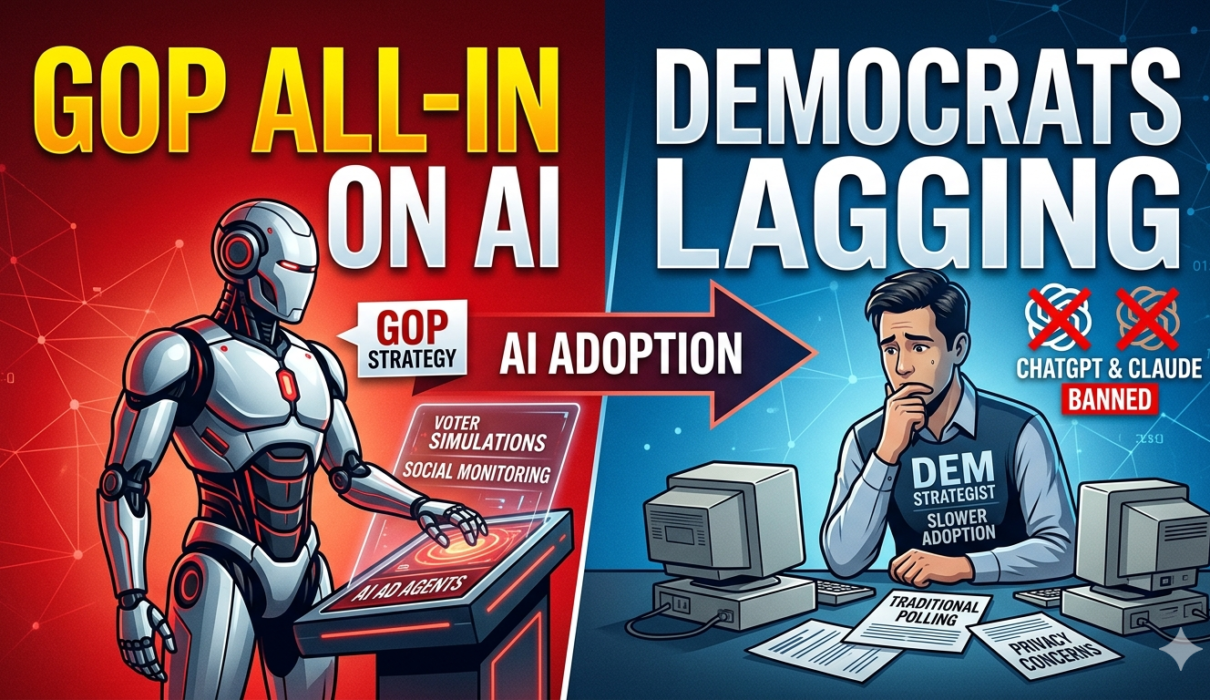
Republican operatives are deploying AI to rapidly simulate voter attitudes toward breaking news events—including the Iran war—and to monitor millions of social media accounts for real-time shifts in public opinion. Looking ahead, at least one Republican operative confirms that AI agents are being developed to interact directly with voters by phone in an effort to persuade them to support GOP candidates.
Democrats, by contrast, have been significantly slower to adopt AI in their campaigns. Many Democratic operatives cite concerns over privacy risks and anxiety about what widespread AI adoption could mean for their own. With few exceptions, the party has largely stayed out of AI-generated advertising.
DNC Bans ChatGPT and Claude—but Allows Gemini
The Democratic National Committee has barred staffers from using ChatGPT and Claude, though it does permit the use of Google’s Gemini for coding, data analysis, and related tasks. A DNC official stated that Gemini was approved under a new policy due to its compatibility with the committee’s existing tools and noted that staff AI usage has grown this year as a result.
“There are many Democrats who are using AI, but there’s also a lot of skepticism,” Democratic strategist Larry Huynh told Axios. “I don’t see the same level of skepticism on the Republican side.”
That gap is backed by data: a recent survey by the American Association of Political Consultants found that 64% of Republican consultants use AI daily in their work, compared to 49% of Democrats.
Key AI Tools Republicans Are Using to Win Elections
Aaru—AI-Powered Voter Simulation
One of the most prominent tools in the Republican AI arsenal is Aaru, a behavioral prediction platform that replicates voter pools using AI agents. These bots can be surveyed on their views—such as opinions on a specific candidate or how President Trump is handling a given issue.
GOP operatives who have used Aaru report that it accurately models what a universe of voters in a given area looks like and does so far faster and at a fraction of the cost of traditional polling. Before airing campaign ads, the platform can also test their predicted effectiveness.
MiroFish: The platform can test the anticipated efficacy of campaign advertisements prior to their broadcast. Simulated Public Opinion Forecasting
Republicans are also turning to MiroFish, a platform that forecasts public opinion using simulated people. Campaign operatives can upload polling data and news stories, then query the platform to predict how voters might respond to major events—such as the conclusion of the Iran war.
EyesOver—Real-Time Social Media Trend Monitoring
EyesOver, a program that scans millions of social media pages daily to detect real-time shifts in public sentiment, is also gaining traction among GOP strategists. “It’s super accurate at predicting trends,” one Republican operative said.
The White House and NRSC Lead the GOP’s AI Push
The White House’s digital team has set the aggressive tone for the party’s AI strategy, regularly publishing AI-generated social media content that promotes President Trump and targets his critics. The National Republican Senatorial Committee is using AI to produce advertisements, analyze campaign data, and identify new small-dollar donors, according to an NRSC spokesperson.
Among the AI-generated content produced so far are more than half a dozen targeted ads aimed at Democratic Senate candidates—including a video game-themed spot attacking Democratic candidates in Michigan. Republicans argue these AI-produced ads are both cheaper and faster to create than traditional campaign commercials.
The Risks of AI in Political Advertising: Deepfakes and Voter Backlash
Despite the enthusiasm, some Republican operatives are sounding the alarm about the dangers of AI-generated political content—particularly deepfakes. They warn that most voters can now distinguish between authentic and artificially generated media and that campaigns caught manipulating reality risk serious backlash.
Even provocative AI ads, operatives caution, could alienate voters who are increasingly frustrated by what they see as AI-generated junk content flooding their social media feeds—or worse, lead them to question the honesty of the campaigns producing it.
The risks were illustrated recently when Mike Collins, a GOP Senate candidate in Georgia, released a deepfake advertisement in November depicting Democratic Senator Jon Ossoff appearing to endorse a government shutdown.
“They say it’ll hurt farmers, but I wouldn’t know. “I’ve only seen a farm on Instagram,” the fabricated video portrays Ossoff as saying—words he never actually spoke.
Ossoff’s campaign condemned the ad as deliberate deception, stating, “Georgians don’t take well to people who lie to them.” Collins defended it, saying, “Our team is doing it just like the White House.”