

 By
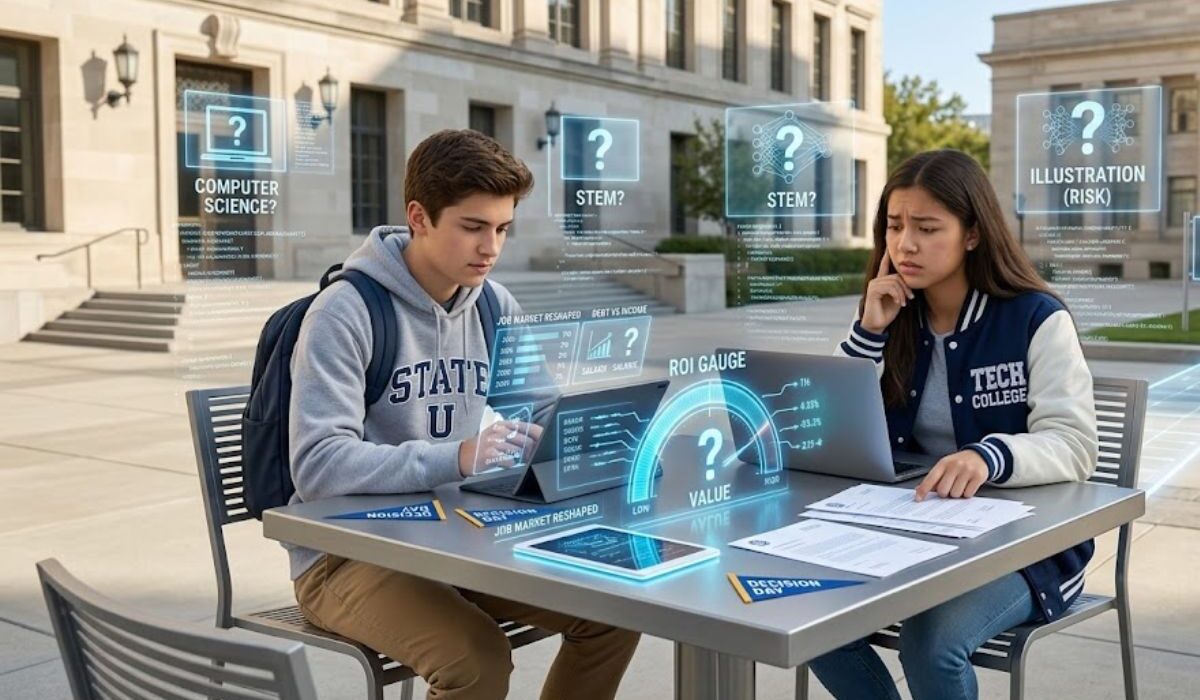
By As the traditional May 1 College Decision Day approaches, students and parents are facing a new, unprecedented challenge: calculating the return on investment (ROI) of a college degree in a labor market rapidly being reshaped by artificial intelligence.
Majors that were once considered guaranteed “golden tickets”—such as computer science—are now being heavily scrutinized as AI continues to transform the tech industry and alter expectations for entry-level jobs.
The Staggering Cost of Uncertainty For many families, the unpredictable nature of the future job market is clashing head-on with the soaring costs of higher education:
- Rising Tuition: For the 2025–2026 school year, average tuition and fees grew by 3.4% for out-of-state public universities (reaching $31,880/year) and by 4% for private nonprofit colleges (reaching $45,000/year).
- Mounting Debt: The average student loan debt at graduation is now $39,457—a 41% increase since 2007 when adjusted for inflation.
With repayment plans becoming less favorable, parents are increasingly reluctant to let their children take on massive debt for career paths that might not exist in a few years.
Steering Away from the Unpredictable This uncertainty is actively changing how parents advise their kids. Many are pushing their children toward fields they perceive as “AI-proof” while actively discouraging them from others.
- The Creative Risk: Some parents are outright refusing to fund degrees in easily automated creative fields, like illustration, fearing AI has already taken over those entry-level roles.
- The Income Focus: With college described by some parents as “highway robbery,” there is a heightened focus on pragmatic degrees that directly translate to high-earning jobs.
The Rise of “AI-Proof” Alternatives Because the traditional four-year college path feels riskier, families are looking at alternative routes that offer faster entry into the workforce with less financial exposure. Trade schools, community colleges, and military service are increasingly viewed as safer, cost-effective bets against AI disruption.
The Bottom Line While higher education experts point out that college graduates still earn about 60% more over their lifetimes than high school graduates and face lower unemployment rates, that generalized statistic is no longer enough to ease minds. The actual return on a college education now varies wildly depending on the specific major—and how well that field adapts to the demands of an AI-driven workforce.