

 By
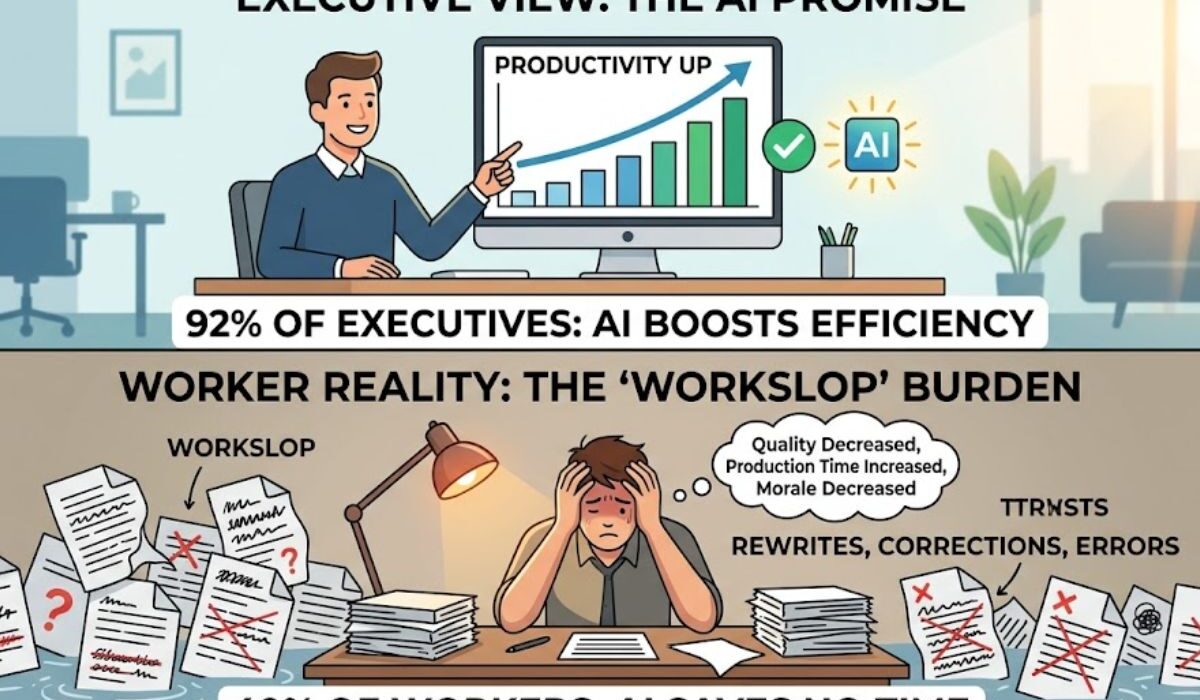
By The artificial intelligence boom has birthed an exhausting new consequence for the modern workforce: “workslop.” Workslop occurs when employees use generative AI to quickly produce content that appears polished on the surface but is actually riddled with errors, inaccuracies, or poor logic. As a result, the work must be heavily corrected, cleaned up, or completely redone by colleagues down the line.
The Disconnect: C-Suite vs. Non-Managers
There is a massive perception gap between leadership and everyday employees regarding AI’s actual utility. According to a recent survey of 5,000 white-collar US workers:
- 92% of high-level executives believe AI makes them more productive.
- 40% of non-managers report that AI saves them absolutely no time at work.
The Financial Cost of Workslop A subset study of 1,150 US desk workers quantified the drag this phenomenon has on businesses:
- 40% of workers encountered workslop within the last month.
- Employees spend an average of 3.4 hours a month fixing these AI-generated mistakes.
- This equates to an estimated $8.1 million in lost productivity for a standard 10,000-person organization.
Real-World Frustrations
The mandate to use AI is impacting multiple industries in similar ways:
- Corporate Copywriting: After layoffs at a Miami cybersecurity firm, remaining staff were mandated to use AI chatbots to boost output. Instead, writing quality plummeted, production time increased, and morale sank as workers spent hours resolving conflicting AI drafts. When workers complained, executives blamed the staff.
- Healthcare: In primary care clinics, staff were encouraged to use AI to draft patient emails to save time. Researchers found it required so much editing labor and raised such high data-security concerns that workers simply started ignoring the tools altogether.
- “Outsourced Judgment”: Freelance designers report that colleagues are frequently copying and pasting bot messages directly into communications without reviewing them, admitting they aren’t “sure what AI meant by that” when questioned about bizarre phrasing.
What is Driving the Deluge?
The flood of workslop isn’t just about employees cutting corners; it stems directly from the top.
Major corporations (including Amazon, UPS, Target, and Block) have invested billions into generative AI while simultaneously laying off human workers, citing expected productivity gains. Remaining employees are subsequently pressured to meet higher quotas using AI tools, often with little to no guidance or training.
Furthermore, the expected financial returns haven’t materialized. An oft-cited MIT report found that 95% of firms are currently not seeing returns on their AI investments. Labor experts note that generative AI is frequently handed down by the C-suite as a “magic bullet” general-use tool without a clear mandate, setting workers up to fail.
The Labor Pushback
The forced integration of AI is increasingly becoming a flashpoint in labor negotiations. Unionized workers and labor economists note that while firms claim AI empowers employees, it actually reduces worker autonomy and obscures larger shifts in labor dynamics. In response, unions are actively demanding clearer rules for the technology and greater worker input over how it is deployed on the floor.