

 By
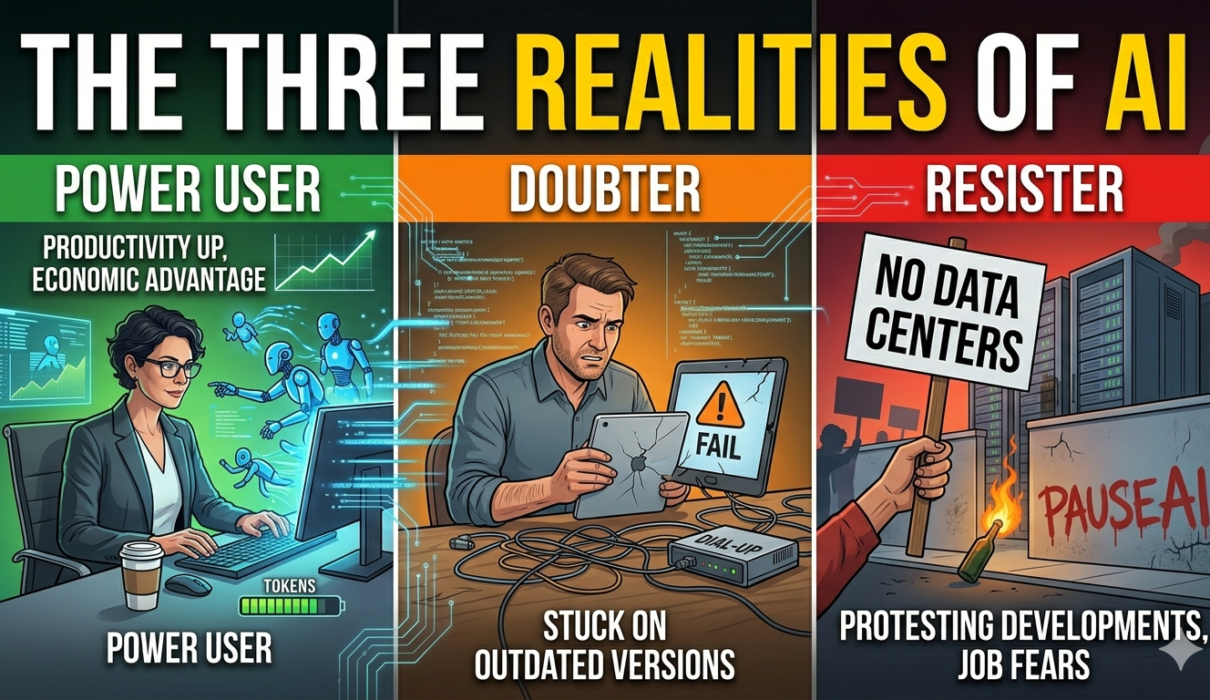
By Artificial intelligence is no longer a single story—it’s three completely unique ones. As AI technology accelerates, three distinct groups are emerging: power users who are fully embracing it, doubters who remain skeptical, and resisters who are actively pushing back. To comprehend the future of AI adoption and the growing divide, it’s crucial to understand these camps.
Why the AI Divide Matters
AI isn’t just changing how we work — it’s reshaping how people see the world. The gap between full AI users and total AI rejecters is widening fast, with consequences appearing everywhere: from rising job-loss fears and data center protests to real-world violence.
The Three AI User Groups Explained
1. Power Users: Fully Committed to AI Power users operate AI agents continuously, automating work and decision-making. Andrej Karpathy, former AI lead at OpenAI and Tesla, recently shared on X that he now spends 16 hours a day issuing commands to AI agent swarms and rushes to exhaust his token limit every month. These users don’t just dabble—they live inside AI ecosystems.
2. Doubters: Stuck on an Outdated Version of AI Doubters still associate AI with glitchy chatbots and viral fails. They’re not tapping into its full capabilities, often forming their entire opinion from a single session with a free-tier tool. As Karpathy noted, letting one underwhelming ChatGPT interaction define your view of AI is like judging the internet by a slow dial-up connection.
3. Resisters: They Understand AI—and Want No Part of It Resisters are perhaps the most misunderstood group. They aren’t dismissing AI out of ignorance — many understand it well. They simply don’t like where it’s headed. And increasingly, they’re making their opposition known.
The Growing Productivity Gap Between AI Users
The divide isn’t just philosophical — it’s economic. AI power users are pulling ahead in productivity and output, creating a new kind of digital wealth gap.
Anthropic’s March 2024 economic impact report found that experienced AI users attempt more complex tasks and succeed at higher rates than casual users. Box CEO Aaron Levie summed it up on X: “AI adoption is a tale of two cities.”
The cycle reinforces itself: the more someone uses AI, the better their results — and the further they pull ahead of those who don’t.
Anti-AI Sentiment Is Turning Into Action
Resistance to AI is no longer limited to online debates. Protests are becoming more frequent in San Francisco, home to many of the world’s leading AI companies, and in communities targeted for new data center construction.
Recent incidents highlight the escalating tension:
- A legislator in Indianapolis reported his home was struck by gunfire, with a note left behind reading “no more data centers.”
- A man was arrested for allegedly throwing a Molotov cocktail at the home of Sam Altman, the CEO of OpenAI. He had also previously visited OpenAI’s offices. The San Francisco Chronicle reports that someone with the same name had published anti-AI essays and participated in a PauseAI Discord server—an activist group advocating for a halt to AI development.
Meanwhile, a viral post from a Meta engineer captured the anxiety spreading through the tech industry: “I’m done with tech and I’m done with this unfair world.” A growing number of skilled technical workers fear AI will make their expertise obsolete.
Sam Altman Responds: “The Fear Is Justified”
Following the attack on his home, OpenAI CEO Sam Altman addressed public fear directly. Rather than dismissing concerns, he acknowledged them head-on.
“It will not all go well,” Altman wrote. “The fear and anxiety about AI are justified; we are in the process of witnessing the largest change to society in a long time, and perhaps ever.”
The Bottom Line
The people building and using AI at full power are living in a fundamentally different world from everyone else. As that gap widens, so does the potential for misunderstanding, anxiety, and conflict. The three realities of AI aren’t converging — they’re drifting further apart.