

 By
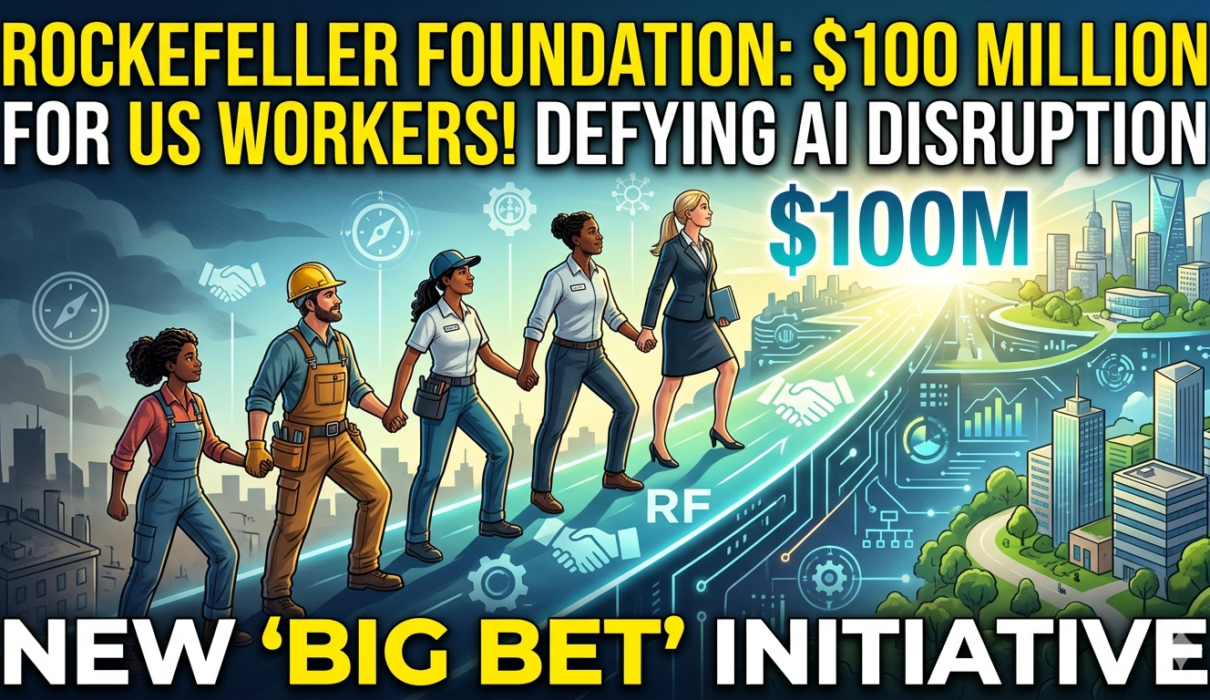
By The Rockefeller Foundation has announced a $100 million initiative aimed at helping U.S. workers adapt to technology-driven changes reshaping the labor market, with a particular focus on communities most vulnerable to AI-related job displacement.
Why This $100M AI Jobs Initiative Matters
Artificial intelligence is already transforming jobs that local economies depend on. Whether private-sector workforce initiatives like this one can scale quickly enough may determine if AI technology widens or narrows America’s growing economic divide—particularly for working-age adults in at-risk communities.
About the “Big Bet on Good Jobs for America” Program
The initiative, officially titled “Big Bet on Good Jobs for America,” is a three-year, $100 million commitment designed to create 1.6 million additional good jobs nationally across 250 locations. It specifically targets communities where workers face a high risk of AI-driven job loss or where significant employment disruption has already occurred.
Derek Kilmer, a former Democratic congressman from Washington state and now a senior vice president at the Rockefeller Foundation, told Axios that “good jobs” under this initiative include roles in sectors such as health care and food and nutrition — fields considered resilient to full AI automation.
How the Rockefeller Foundation AI Jobs Program Works
The Rockefeller Foundation will collaborate with local organizations and policymakers to pilot new workforce policies and programs. Key strategies include job training pathways, expanded childcare access, and easing credential requirements that often serve as barriers to employment.
Rather than pre-selecting all 250 target locations upfront, the foundation plans to begin with a pilot group of approximately 20 to 30 communities, identify what works, and then scale those solutions nationally. Locations will be chosen based on underlying labor market conditions, including employment gaps and employer demand for workers.
One early program concept involves covering upfront training costs for workers entering health care jobs—directly lowering the financial barrier to career transitions in a high-demand sector.
AI Disruption Is Sidelining Working-Age Americans
Kilmer emphasized that AI is accelerating economic disruption at a pace that is actively pushing working-age Americans out of the labor market. “When we are at these moments of profound economic change, societies have a choice: either to help people in places adapt or absorb the consequences for decades,” he said. “That’s why we’re leaning into this now. Success looks like attaching more working-age Americans to good jobs.”
The foundation is also exploring how AI itself can be part of the solution — for example, by using the technology to speed up permit processing for affordable housing development, helping communities grow sustainably alongside the economic transition.
Private Philanthropy Filling a Federal Funding Gap
A notable trend is emerging: private philanthropy and local workforce initiatives are moving faster than the federal government to fund programs addressing AI-related job loss and worker displacement. Whether efforts like the Rockefeller Foundation’s commitment can keep pace with the speed and scale of AI-driven labor market disruption remains an open and critical question for the future of American workers.
Read more on our website