

 By
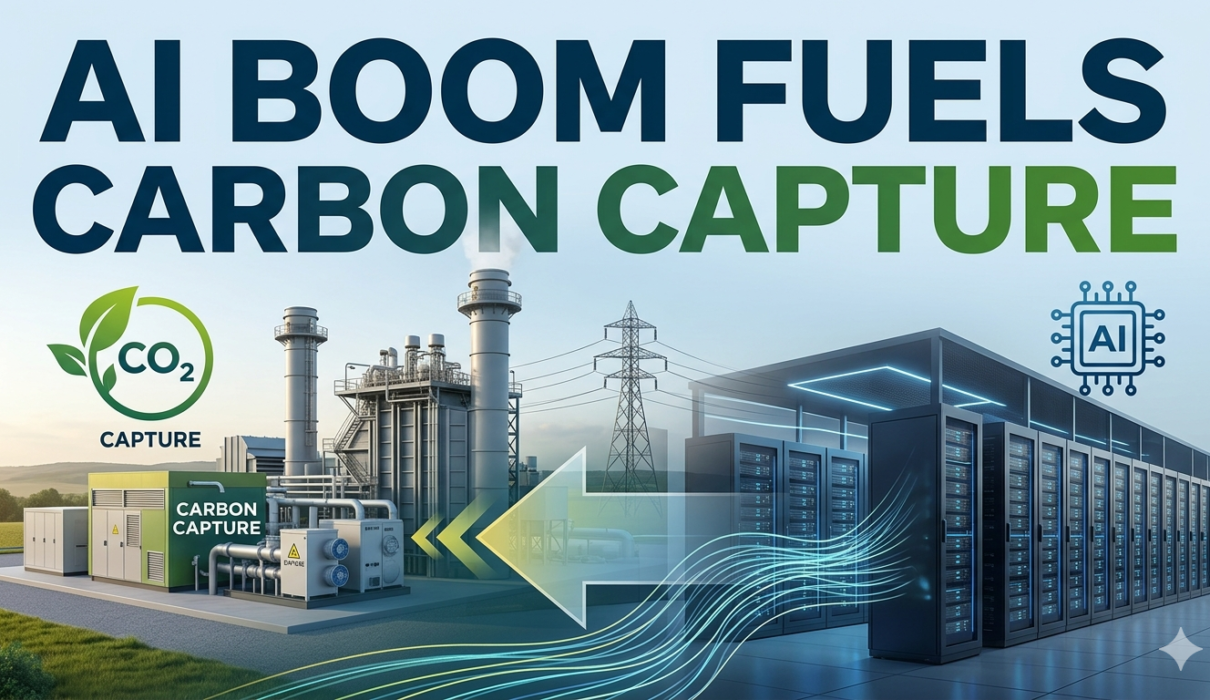
By Carbon capture technology for natural gas power plants may finally reach its commercial breakthrough—and the AI boom is the catalyst driving it forward.
Why Carbon Capture Matters in the Age of AI
Carbon capture and storage (CCS) technology — which removes CO₂ emissions directly from natural gas power plants — has long been considered too expensive to deploy at scale. But the explosive growth of artificial intelligence and the surging power demands of data centers could change that equation dramatically.
As Big Tech races to power the AI revolution while honoring ambitious climate commitments, carbon capture is emerging as a critical solution at the intersection of energy, climate, and technology investment.
Big Tech Companies Are Driving Carbon-Capture Investment
At least five major carbon capture projects are currently under consideration across the United States, all linked to natural gas plants powering data centers. These include:
- Google’s announced project in Illinois, and a second project reportedly underway in Nebraska
- ExxonMobil and Chevron both developing carbon capture initiatives
- Meta’s project, which includes an option to integrate carbon capture technology
Multiple senior executives across both the energy and AI sectors confirm that carbon capture is now a top-of-agenda discussion.
“Big tech companies will be the leaders in demonstrating carbon capture,” said KR Sridhar, co-founder and CEO of Bloom Energy — a leading fuel cell manufacturer facing surging demand from data centers. “I strongly believe carbon capture use and storage will be the only way we will decarbonize the planet in a big way over the next two decades.”
Bloom Energy is currently in early-stage talks with multiple hyperscalers about deploying carbon capture technology, though Sridhar indicated formal announcements are expected next year.
The AI Energy Dilemma: Climate Goals vs. Power Demand
The rapid expansion of AI infrastructure is driving unprecedented electricity demand, fueling growth across nearly every energy technology — from natural gas and nuclear fusion to long-duration storage solutions.
However, Big Tech faces a growing tension: maintaining strict climate pledges while relying increasingly on carbon-intensive natural gas.
“Unabated natural gas is being pursued by all the hyperscalers no matter how stringent their climate goals,” said Alex Dewar, Managing Director at BCG and author of a recent industry report on the topic. “That’s where the solution does come back to carbon capture.”
Carbon Capture + Natural Gas: The Data Center Power Solution
Gas-fired power plants equipped with carbon capture technology are emerging as a uniquely attractive energy option for data centers, which require reliable, 24/7 baseload power.
A recent BCG analysis ranked gas-plus-carbon-capture as the only power source that scored consistently well across all four critical metrics — cost, speed, scalability, and emissions — when compared against eight competing energy technologies.
A separate report from the Great Plains Institute identified the Gulf Coast, West Texas, and Oklahoma as the most promising regions for this type of buildout.
Market Potential: Up to $80 Billion in Investment
The financial opportunity is significant. BCG estimates that up to $80 billion could be deployed in new natural gas plants and retrofits equipped with carbon capture technology if the sector reaches scale.
Key Challenges Still Facing Carbon Capture
Despite growing momentum, major hurdles remain before carbon capture becomes commercially widespread:
- No U.S. natural gas plants currently operate with carbon capture equipment, though global and domestic progress is slowly advancing across other facility types
- A federal tax credit — currently set to expire in 2033 — remains essential to project viability
- High upfront capital costs persist, even with subsidies offsetting some operating expenses
- “The biggest hurdle is the scale of the capital required,” Dewar noted
“To be certain, it’s still a technology that has a long way to go before it can be commercialized at scale,” said Michael Terrell, Head of Advanced Energy at Google. “And we’re committed to helping get it there.”
From Pipeline to Reality: What’s Next for Carbon Capture
The gap between industry talk and real-world deployment has long defined the carbon capture sector. Companies like data center developer Crusoe have signaled interest for years, with co-founder and president Cully Cavness stating, “We have not yet announced a project… but we’re pursuing several opportunities. Ultimately, it’s an economics question.”
However, signs of genuine momentum are building.
“There’s a lot more in the pipeline than what’s publicly known,” said BCG’s Dewar. “We’re seeing a shift to smaller-scale projects to demonstrate the technology and scale up from there.”
Bottom Line
The AI-driven energy boom is creating a powerful new incentive for carbon capture deployment that hasn’t existed before — deep-pocketed tech companies with climate commitments and the balance sheets to back them up. Whether this momentum translates from boardroom discussions into operational projects will be the defining question for the technology’s future.