

 By
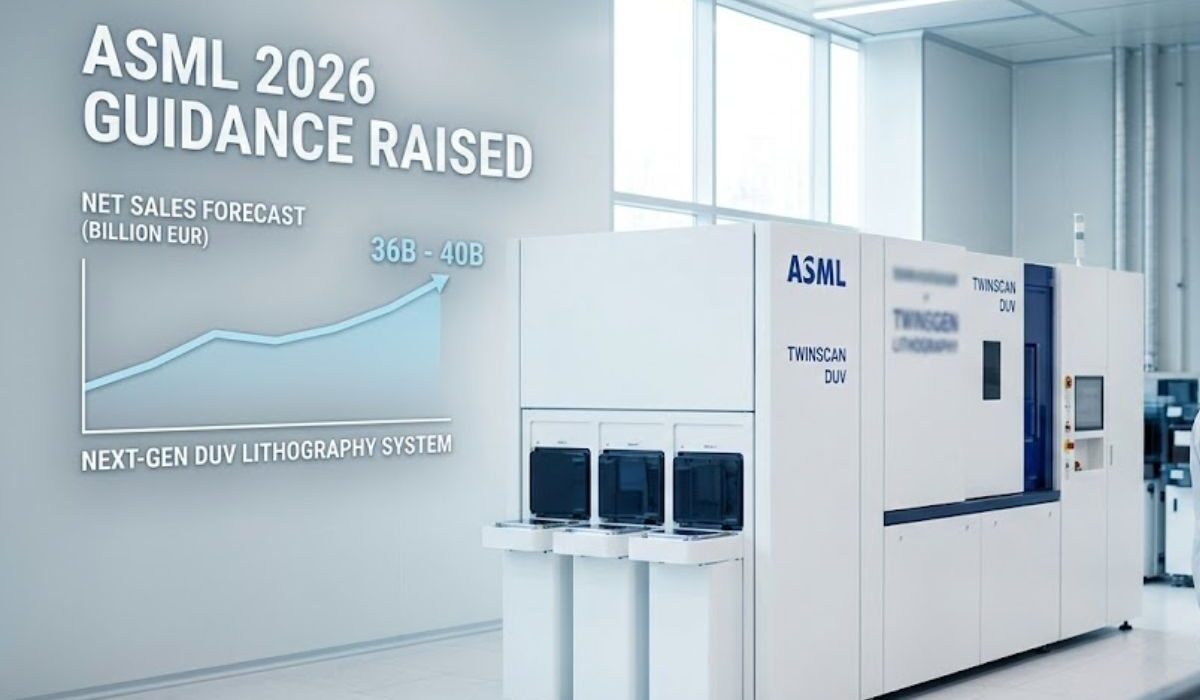
By Dutch semiconductor equipment manufacturer ASML has raised its sales forecast for 2026 after comfortably beating first-quarter revenue and profit expectations. The company, widely considered a bellwether for the global chip industry, points to the relentless demand for AI-related infrastructure as the primary driver of its continued growth.
Q1 Earnings: Beating Expectations ASML’s first-quarter performance surpassed Wall Street’s consensus estimates, falling near the high end of its own previous guidance:
- Net Sales: €8.8 billion ($10.4 billion), beating the expected €8.5 billion.
- Net Profit: €2.8 billion, topping the projected €2.5 billion.
Following these strong results, ASML increased its 2026 net sales forecast to a range of €36 billion to €40 billion, up from its previous projection of €34 billion to €39 billion.
The AI and Memory Chip Boom According to ASML CEO Christophe Fouque, the semiconductor industry’s growth outlook is rapidly solidifying. “Demand for chips is outpacing supply,” Fouque noted, prompting customers to accelerate capacity expansion plans for 2026 and beyond.
A massive part of this growth is coming from the memory chip sector, which is essential for AI systems and data centers.
- The Memory Surge: 51% of ASML’s net sales for new tools in Q1 went toward memory production, a massive jump from just 30% in the previous quarter.
- Key Players: South Korean tech giants Samsung and SK Hynix are aggressively ramping up production to meet the unprecedented demand and soaring prices for memory chips, driving heavy reliance on ASML’s machinery. Consequently, customers in South Korea accounted for 45% of Q1 sales, while Taiwan (home to ASML’s top customer, TSMC) represented 23%.
Geopolitical Headwinds in China Despite the overall boom, ASML is navigating significant challenges in China. Due to strict export restrictions, the company is already prohibited from shipping its most advanced manufacturing machines to Chinese firms.
The pressure is only mounting: a bipartisan group of U.S. lawmakers recently introduced legislation that would expand these bans to include ASML’s less-advanced equipment. As a result of these geopolitical tensions, system sales to China dropped sharply to just 19% of ASML’s overall sales in the first quarter, down from 36% in the previous quarter.