

 By
By Business · Artificial Intelligence · Corporate Strategy · Investor Insights
S&P 500 companies are moving beyond AI buzzwords. According to a new analysis of investor earnings calls, a growing number are now disclosing specific, measurable results from their AI investments—from designing toys faster to slashing marketing production time.
Why corporate AI adoption now matters more than ever
A few years ago, the majority of companies were merely acknowledging the existence of artificial intelligence. Today, they are offering concrete, quantifiable details about how AI is changing their operations, cutting costs, and reshaping their workforces.
New data: AI impact disclosures double among S&P 500 companies
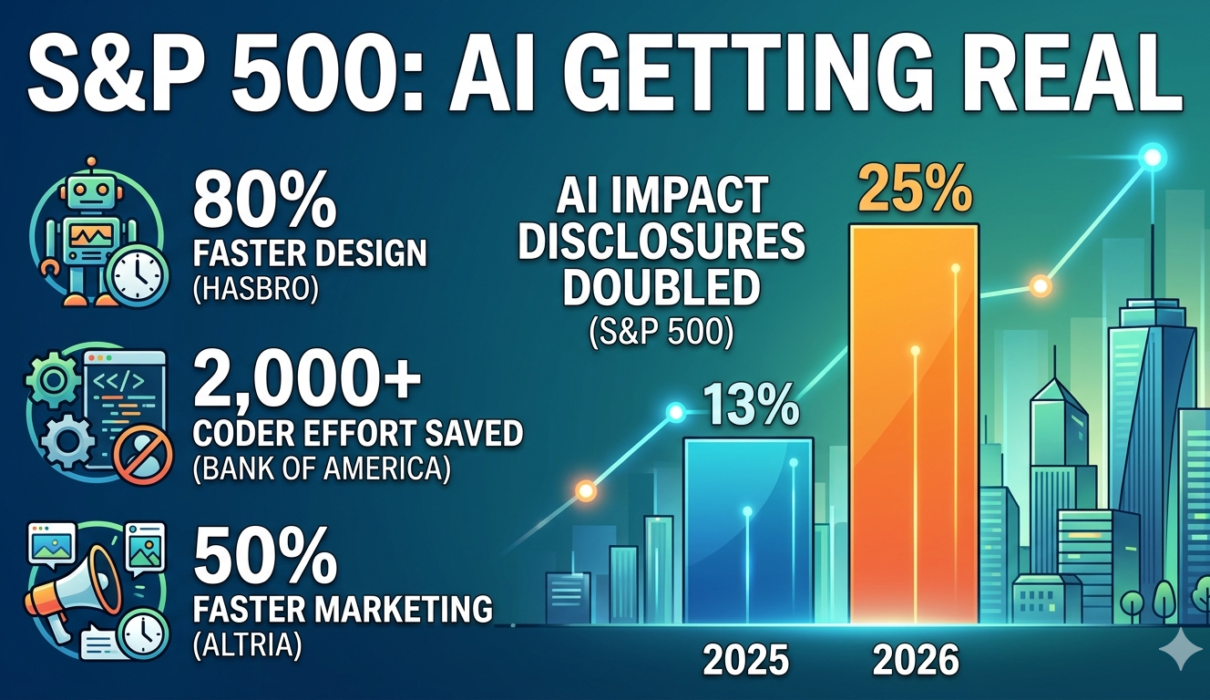
One-quarter of S&P 500 companies mentioned at least one quantifiable impact from AI in the first three months of 2026— up sharply from 13% during the same period in 2025. The figures come from a Tuesday report by Morgan Stanley, which used AI itself to analyze investor earnings call transcripts.
Which industries are leading AI adoption?
Breaking the data down by sector reveals a clear pecking order:
- Technology — 42% of tech companies highlighted tangible AI benefits. This comes as no surprise: AI-assisted “vibe coding” has upended software development, and employer demand for traditional software engineers has declined noticeably.
- Finance — 40% of financial companies reported measurable AI gains, up dramatically from just 15% the prior year.
- Communications services— ranked third overall in reported AI impact.
AI adoption is outpacing even the internet revolution
The broader trend is striking: the pace of AI adoption across corporate America is accelerating faster than internet adoption did at the turn of the century, even as geopolitical tensions and economic uncertainty continue to rise.
Morgan Stanley equity analysts noted that since the launch of ChatGPT in late 2022, AI has emerged as a defining force across markets, fundamentally reshaping how companies operate, invest, and compete. They added that companies across industries are beginning to realize tangible gains through technology diffusion, echoing patterns seen in previous major technology cycles.
Real-world examples: how major companies are using AI right now
The Morgan Stanley report highlighted several concrete case studies of enterprise AI in action:
- Hasbro is using AI-assisted design to cut the time from concept to physical prototype by roughly 80%, while noting that humans still make all final product decisions.
- Bank of America reports that AI saves the equivalent of around 2,000 employees who would otherwise be writing codes. CEO Brian Moynihan has spoken about allowing headcount to “drift down” as a result of AI-driven productivity gains.
- Altria achieved a 50% reduction in the time required to produce marketing content using AI tools.
Reality check: most companies still can’t quantify AI’s impact
Despite the progress, 75% of S&P 500 companies still did not point to any quantifiable AI benefits in the Morgan Stanley analysis. A comparable study from Goldman Sachs, released last month, found that only 10% of S&P 500 firms cited AI impact in specific use cases, though roughly half discussed AI in the context of productivity gains. Goldman analyst Ronnie Walker did find that 70% of firms were at least talking about AI in some capacity.
What business leaders expect next: the productivity boom is still ahead
A survey of nearly 6,000 business executives conducted earlier this year found that while the vast majority are already using AI technology, most have not yet reported a significant measurable impact on their companies over the past three years. However, executives broadly predict that the productivity payoff will materialize over the next three years.
Kevin Khang, senior global economist at Vanguard, describes the current moment as the second part of the first phase of AI adoption—and expects the pace to accelerate considerably from here. AI is now the top priority on virtually every CEO’s agenda this year.
The bottom line: billions invested, every gain gets amplified
Companies are pouring billions of dollars into AI tools and infrastructure — and with that level of investment comes a powerful incentive to highlight every measurable win. Corporate AI adoption is still in its infancy.