

 By
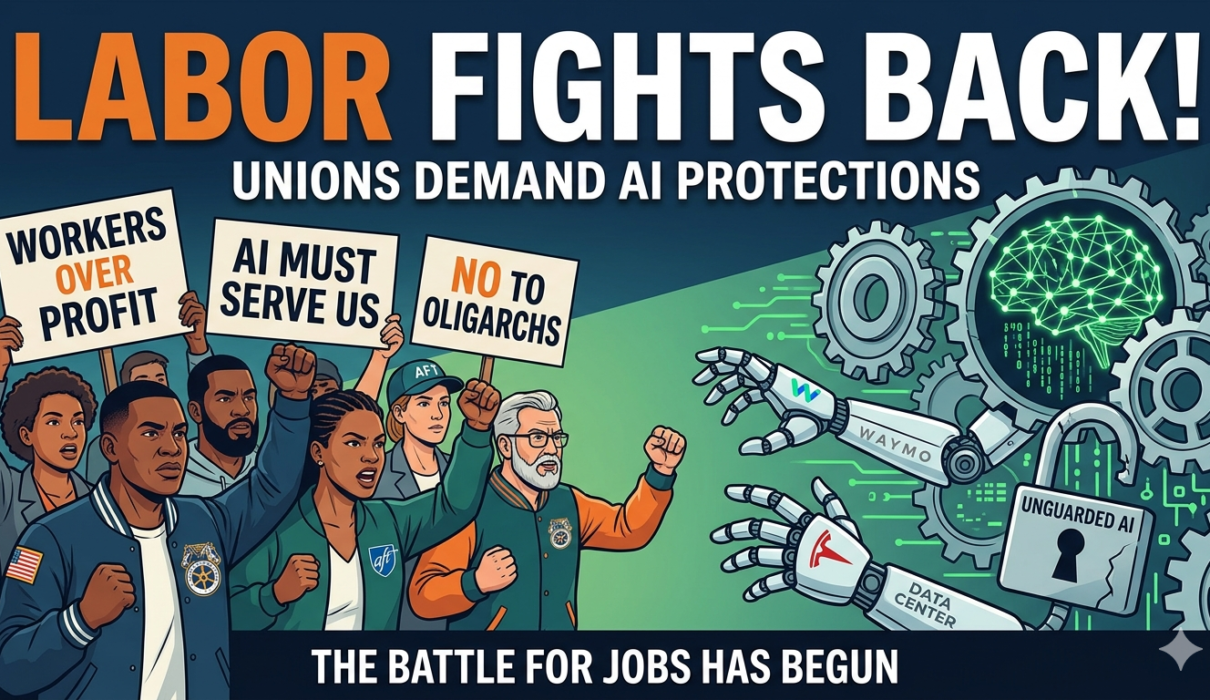
By Union leaders across the United States are escalating their opposition to unchecked artificial intelligence expansion, calling out the industry’s most powerful figures as profit-driven “oligarchs” who are eager to replace human workers with automation. As the emerging AI economy takes shape, the labor movement is making clear it intends to have a seat at the table.
Why the Labor Movement’s Fight Against AI Matters
The rules governing the AI-driven economy are still being written — and unions see this moment as a critical window to influence the outcome. With AI threatening to reshape industries from transportation to manufacturing, labor organizations are moving from cautious concern to open confrontation.
Union Leaders and Bernie Sanders Unite Against “AI Oligarchs”
Leaders from some of the country’s largest unions gathered alongside U.S. Sen. Bernie Sanders (I-Vt.) to publicly condemn what they called the reckless, worker-hostile rollout of artificial intelligence. The press conference drew senior figures from the AFL-CIO, UAW, Teamsters, and the American Federation of Teachers—a rare show of a unified labor force against AI job displacement.
Sanders did not hold back in naming names:
“The richest people on Earth—Mr. Musk, Mr. Zuckerberg, Mr. Bezos, Mr. Ellison, and others—what they want to do is replace human workers. Some of us are old-fashioned, and we believe in human beings.”
AFL-CIO president Liz Shuler echoed the alarm, warning that the current trajectory of AI development is putting profits over people:
“We are here to sound the alarms on AI. This race that everybody seems to think we’re in to advance AI at all costs—with no guardrails or protections for people—is reckless and dangerous.”
UAW president Shawn Fain framed the issue as a matter of economic justice, arguing that AI automation and workers’ rights are in direct conflict when the gains flow only to the wealthy:
“A handful of billionaires want all the profits — but the working class has to get our fair share. Human beings have to come first in this equation, not an afterthought.”
AI and Robotaxis: The Front Line of the Jobs Battle
Opposition to AI and robotics has been building steadily in labor circles, but nowhere is the tension more visible than in the robotaxi and autonomous vehicle industry.
Self-driving technology poses a direct threat to millions of professional drivers—truckers, taxi drivers, and bus operators whose livelihoods depend on skills that AI aims to automate. Teamsters president Sean O’Brien—who has recently grown closer to President Trump—has called on the federal government to require a human safety driver in all robotaxis, a policy demand that directly challenges the business models of companies like Waymo and Tesla.
American Federation of Teachers president Randi Weingarten broadened the concern beyond transportation:
“We need Congress; we need this administration to actually put people first—to make sure that the human being is in charge of society, not a robot and not a chatbot.”
Acknowledging AI’s Inevitability While Fighting Its Consequences
Despite the sharp rhetoric, a thread of pragmatism runs through the labor movement’s response to AI. Even Sanders—one of AI’s harshest critics in Washington—acknowledged the likely trajectory of the technology:
“What experts tell us is, if there is not a counterreaction, it is very likely that millions and millions of truck drivers, bus drivers, and taxi drivers will lose their jobs within the next decade.”
There may even be unexpected common ground between AI advocates and labor leaders. UAW’s Fain has been pushing for a 32-hour work week — a demand that some AI proponents have themselves floated as a potential benefit of productivity gains driven by automation. Whether that shared vision can bridge the current divide remains to be seen.
Sanders Calls for a Moratorium on AI Data Centers
Beyond rallying rhetoric, Sanders is taking concrete legislative aim at the AI industry. He is working to pressure Congress to place a moratorium on new AI data centers while policymakers assess their broader economic and social impact.
“How the hell do you go forward and throw millions of people out on the street without planning what’s going to happen?” Sanders said.
The proposal reflects a growing demand among labor unions and AI regulation advocates for a pause-and-plan approach—ensuring that AI workforce policy catches up with the speed of technological change before irreversible damage is done to working-class communities.
The Bottom Line: The Fight Over AI and Workers’ Rights Is Just Beginning
The confrontation between organized labor and the AI industry is no longer a slow simmer—it is reaching a boil. With powerful union coalitions, Senate allies, and millions of workers whose jobs hang in the balance, the labor movement’s opposition to AI is becoming one of the defining political and economic battles of the decade.
The central question is no longer whether AI will transform the workforce. It’s who gets to decide how and who shares in the gains.