

 By
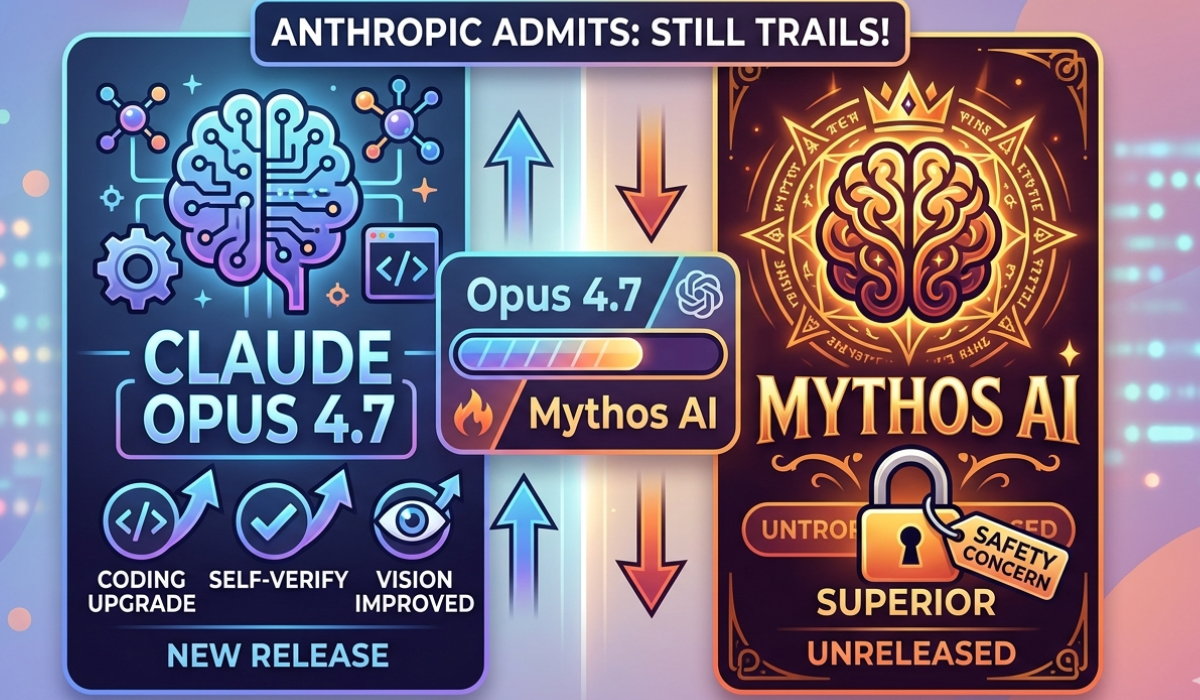
By Anthropic on Thursday released Claude Opus 4.7, a significant upgrade to its flagship AI model featuring improved coding performance, enhanced vision capabilities, and a new self-verification feature that allows the model to double-check its own outputs.
Why the Claude Opus 4.7 Release Matters
In a notable moment of transparency, Anthropic publicly acknowledged that Claude Opus 4.7 does not match the performance of Mythos—a more powerful, unreleased AI system that the company has withheld from general availability due to safety concerns.
Benchmark data included in Anthropic’s official announcement shows that Opus 4.7 outperforms its predecessor Opus 4.6, as well as competing models ChatGPT 5.4 and Google Gemini 3.1 Pro across several key metrics. However, it still falls short of Anthropic’s own Mythos Preview model, which has only been made available to a select group of technology and cybersecurity companies.
What Anthropic Says About Claude Opus 4.7’s Capabilities
In its official blog post, Anthropic described Opus 4.7 as a meaningful leap forward for AI-assisted software engineering. The company noted that the model delivers particular gains on the most difficult coding tasks, with users reporting confidence in handing off complex engineering work that previously required close human supervision.
Anthropic also highlighted substantially improved vision capabilities, with the model processing images at higher resolutions than before. The update also brings refinements to professional creative output — including higher-quality interfaces, slides, and documents — with the company describing the model as more tasteful and creative when completing these tasks.
Claude Being “Nerfed”: The User Complaints That Preceded the Launch
The Opus 4.7 release comes after weeks of vocal user frustration that Claude Opus 4.6 had quietly degraded in quality. An AMD senior director gave voice to a widely held view in a GitHub post that went viral, writing that Claude had regressed to the point it could no longer be trusted for complex engineering tasks.
Speculation spread across developer communities about whether Claude had been deliberately scaled back—a phenomenon users referred to as the model being “nerfed”—either to cut costs or to redirect compute resources toward Mythos and other frontier AI development. Anthropic denied that any changes were made to redirect computing capacity to other projects.
New Claude Code Features: High Effort Level and Task Budgets
Alongside the new model, Anthropic is introducing changes to how Claude Code handles reasoning. Opus 4.7 adds a new xhigh (“extra high”) effort level, sitting between the existing “high” and “max” settings, giving developers finer control over the balance between reasoning depth and response latency on demanding problems. Anthropic recommends starting with either “high” or “xhigh” when testing Opus 4.7 for coding and agentic use cases.
The company is also piloting a new “task budgets” system, which gives developers more granular control over how the model allocates its reasoning effort across longer, multi-step tasks.
Anthropic’s AI Safety Strategy: Using Opus 4.7 to Pave the Way for Mythos
Anthropic said it plans to use the Opus 4.7 deployment as a testing ground for safety guardrails specifically designed to prevent misuse in cybersecurity attacks. The company framed this work as a critical step in its broader AI safety strategy, stating that what it learns from real-world deployment of these safeguards will inform its path toward an eventual public release of Mythos-class models.