
 By
By Advances in AI’s ability to perform novel scientific work are helping researchers accelerate biomedical discovery, bridge siloed knowledge, and design treatments more efficiently, according to a new report from OpenAI’s policy, research, and sciences team.
Why this matters: The life sciences face a productivity crisis
The life sciences sector has saved hundreds of millions of lives over the past century. Yet progress has slowed dramatically—even as the most difficult diseases remain unsolved. Many view AI in drug discovery as a potential solution to this deepening productivity gap.
The big picture: Biomedical discovery moves at a snail’s pace
The pace of biomedical innovation has stalled for structural reasons:
- In the U.S., bringing a new drug from early research to regulatory approval typically takes 12 to 15 years.
- “Eroom’s Law”—Moore’s Law in reverse—holds that scientific progress slows as accumulated knowledge grows, because each new generation of researchers must spend more time absorbing prior work before advancing it.
- AI, by contrast, has no such limitation on absorbing existing knowledge.
How AI is accelerating drug discovery and clinical timelines
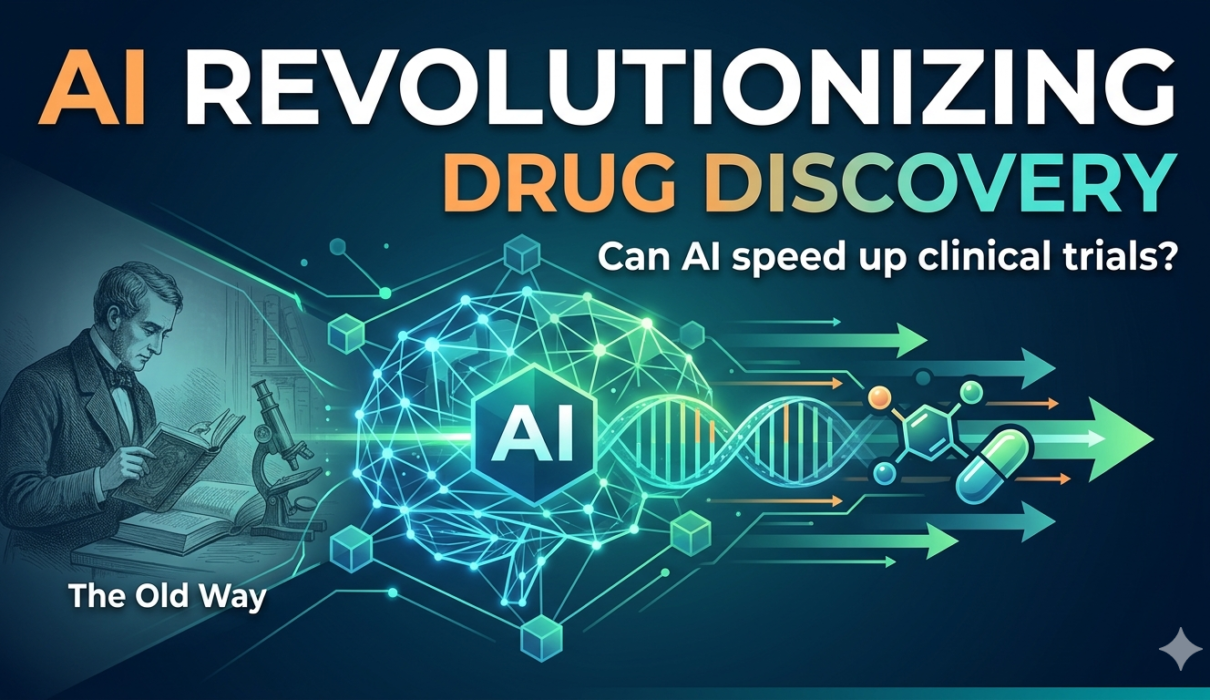
According to OpenAI, artificial intelligence can speed up drug discovery, autonomously design new research tools, and automate laboratory workflows—compressing experiments from months into days.
- One analysis estimated that AI tools could reduce clinical-phase timelines by more than 20%.
- OpenAI argues that GPT-5 Pro is capable of identifying new therapeutic applications for already FDA-approved drugs—particularly for diseases that currently lack effective treatments.
Competitive pressure and big pharma’s growing interest in AI
Rising competition with China and policy shifts in the United States are intensifying pressure to accelerate drug development—making AI-powered solutions increasingly attractive to major pharmaceutical companies. This week, Amazon launched Bio Discovery, an AI agent designed to generate and evaluate potential drug molecules.
OpenAI’s policy pitch: What the report is really calling for
OpenAI’s report is partly a policy document, making the case for regulatory and structural changes that would support broader AI adoption in the life sciences. Specifically, it calls for:
- Expanded access to medical and scientific datasets
- Designating advanced AI systems as a national research resource
- Increased investment in the “physical “stack”—including compute infrastructure, laboratory capacity, energy, and related systems
Reality check: AI drug discovery still has a long way to go
Only a small number of AI-discovered or AI-designed drug candidates have reached clinical trials to date. A mid-2025 paper published in Nature Medicine found that AI-discovered drugs have experienced similar Phase 2 trial failure rates as those discovered through conventional methods. No fully AI-discovered or AI-designed drug has yet completed Phase 3 trials.
The researchers at Nature Medicine pointed out that the question of whether AI can bring about significant and lasting changes to drug development is still unanswered.
AI accuracy and the limits of current models
AI hallucinations, model bias, and other inaccuracies are less frequent than in earlier systems — but large language models are far from error-free. OpenAI states that it rigorously measures accuracy across scientific domains and frames AI as a tool to help scientists synthesize evidence, generate hypotheses, and support analysis—not as a substitute for expert judgment or real-world validation.
The bottom line
AI has real potential to accelerate slow, expensive, and failure-prone drug development — but the proof is still in the pipeline. Until AI-designed therapies begin clearing Phase 3 trials, the technology’s promise in life sciences remains more forecast than fact.