

 By
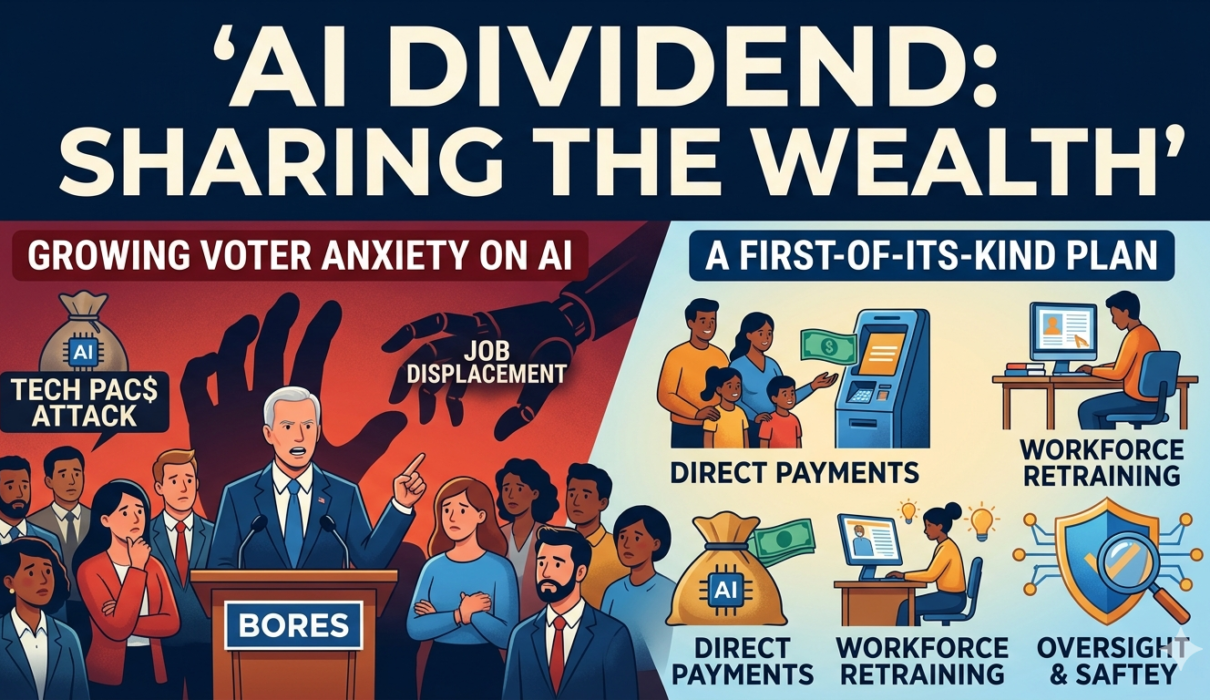
By Alex Bores, a Democratic House candidate in New York and a top target of AI super PACs, is rolling out a plan to create an “AI dividend”—a first-of-its-kind policy designed to ensure Americans share in the economic gains of artificial intelligence if it leads to large-scale job displacement.
Why it matters: Bores is leaning into growing voter anxiety over AI’s impact on jobs and economic inequality, even as deep-pocketed tech interests spend big to defeat him. His proposal puts the question of AI-driven job loss and wealth concentration squarely at the center of his congressional campaign.
Driving the news: Bores’ AI dividend plan, shared exclusively with Axios, comes as AI super PACs funded by tech billionaires ramp up spending against his campaign.
- “At its core, the AI Dividend is simple: if AI dramatically increases productivity and concentrates wealth, the American people have a stake in those gains,” a memo on the policy reads.
- The dividend would fund direct payments to Americans displaced by AI-driven automation.
- It would also be invested into workforce retraining and education programs, as well as government capacity to “govern AI safely and fund independent oversight,” per the plan memo.
—youWhat they’re saying: “You don’t take out fire insurance because you expect your house to burn down — you have insurance in case something goes awry,” Bores told Axios.
- “Here we have, for the first time, a technology where the makers of the technology are explicitly saying that their goal is to replace all human labor.”
- “The fact that they’ve put it out there means government needs to take it seriously.”
Between the lines: Even if Bores’ bid for federal office and his AI wealth distribution plan go nowhere, his focus reflects a broader national uncertainty about how artificial intelligence will reshape daily life and the future of work—a concern that is fast becoming a mainstream voting issue.
Bores’ team describes the AI dividend in the policy memo as a “direct payment program that kicks in if and when AI meaningfully displaces American workers.”
- “It is not a punishment for innovation — it is an insurance policy against automation.”
How it would be funded: The proposal outlines three funding mechanisms:
- A token tax, described as a “modest tax on AI consumption”
- Equity participation in frontier AI firms, giving the public a financial stake in leading AI companies
- Changes to the tax code that would reduce incentives to invest in AI “when it leads to less work”
Bores says the AI dividend is urgent because he believes the window for effective policy solutions will close once mass AI job displacement and concentrated wealth become entrenched.
The intrigue: Bore’s plan echoes warnings that AI CEOs themselves have been giving about automation-driven job losses—and ideas they’ve floated about how Americans can share in the wealth of their companies.
- Still, pro-AI growth super PACs funded by AI billionaires have poured money into defeating Bores.
- In addition to making AI safety and regulation a key part of his congressional campaign, Bores co-authored the RAISE Act, New York’s landmark frontier AI safety law.
- “If AI companies can support this plan, that would show that they actually believe in what they’re putting out there,” Bores said. “If they’re not doing it, then I think it shows that they’re really putting window dressing out there.”
The bottom line: Expect to see more candidates across the country preparing to answer to voter anxiety on AI and job loss. Bores’ AI dividend proposal may be the first, but it is unlikely to be the last.