

 By
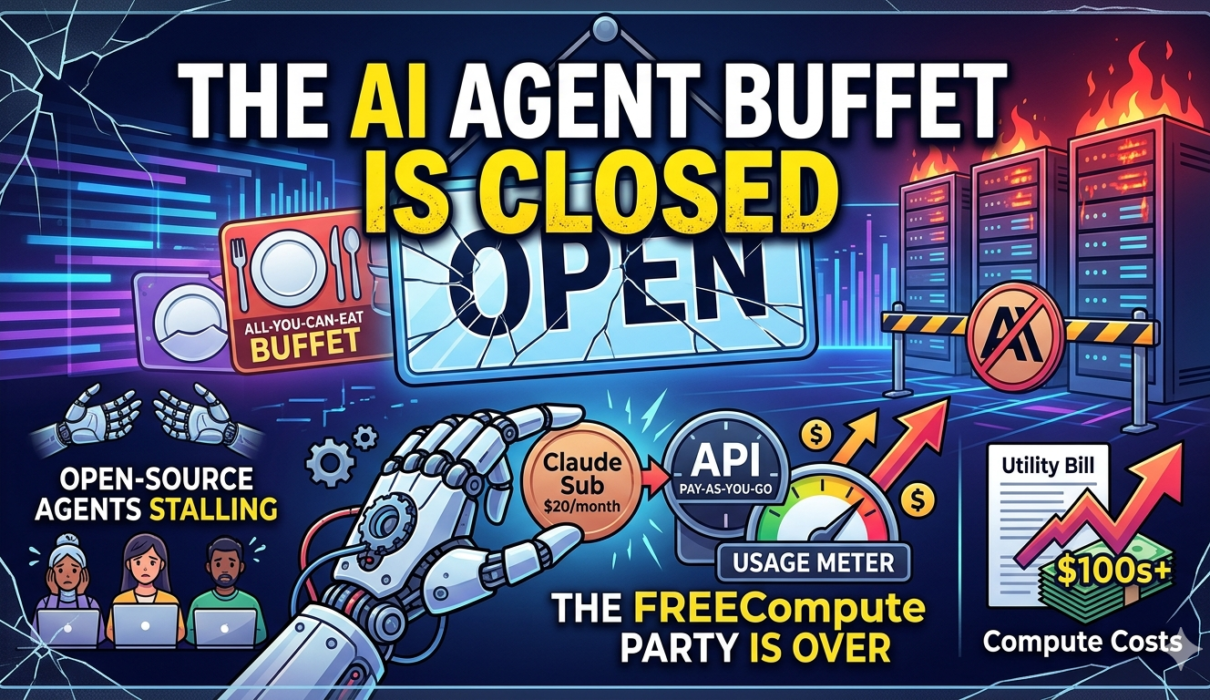
By For a brief, golden window, power users had cracked the code: pay $20 a month and run autonomous AI agents around the clock, burning through compute that should have cost hundreds. Anthropic just shut that window — and the fallout reveals one of the most fundamental tensions in the AI business today.
What Happened
Anthropic quietly ended the party late on a Friday night, when engineering lead Boris Cherny announced on X that Claude subscriptions would no longer power third-party agent tools like OpenClaw — one of the most popular open-source frameworks for running autonomous, continuous AI agents.
The rules now:
- Claude models — Opus, Sonnet, and Haiku — remain accessible through outside agent frameworks
- But users must pay through Anthropic’s API or a new pay-as-you-go “extra usage” system
- The flat-rate subscription loophole is gone
AI product manager Aakash Gupta summarized it cleanly: “The $20/month all-you-can-eat buffet just closed.”
Why This Was Always Unsustainable
OpenClaw and tools like it weren’t designed for casual use. These agents run continuously — sometimes 24 hours a day — executing tasks across multiple applications, chaining hundreds of model calls together in a single session. The token consumption dwarfs anything a normal chatbot conversation produces.
Meanwhile, Anthropic’s $20/month subscription was never priced for that reality. Heavy agent users were essentially accessing high-cost compute at a steep discount, subsidized by the flat-rate structure. The math was never going to hold.
Anthropic had already begun showing signs of strain before this move — introducing five-hour session caps during peak periods and tightening usage limits across the board. Heavy agent traffic wasn’t just expensive. It was crowding out everyday users.
As Cherny put it directly: “Our subscriptions weren’t built for the usage patterns of these third-party tools. Capacity is a resource we manage thoughtfully, and we are prioritizing our customers using our products and API.”
The Backlash
The open-source community didn’t take it quietly.
OpenClaw’s creator, Peter Steinberger — who has since been hired by OpenAI — publicly pushed Anthropic to reconsider and shared workarounds with affected users after the change. Some users are now exploring locally hosted models entirely, looking to escape usage restrictions by taking compute into their own hands.
The frustration is understandable. For developers who built workflows and tools around Claude’s accessibility, this feels like the rules changing mid-game.
The Bigger Strategic Picture
This isn’t just an Anthropic story — it’s a preview of where the entire industry is heading.
Agentic AI is categorically more expensive to run than conversational chatbots. These systems execute for hours, interact with external apps, and consume compute at a scale that no flat-rate subscription model was ever designed to absorb. Someone was always going to have to pay. The question was who and when.
What makes Anthropic’s move notable is what it says about the company’s broader philosophy. While critics have long argued that OpenAI operates with reckless financial ambition — betting that Sam Altman can always raise more capital to cover ballooning compute costs — Anthropic has been quietly pitching Wall Street on a different story: capital efficiency, margin discipline, and sustainable unit economics.
A former employee who worked across multiple frontier AI labs told Axios that the contrast in culture was stark — Anthropic drilled efficiency into how it trains and runs models, while OpenAI operated on the assumption that more funding would always be available to match scaling demands.
Blocking unlimited agent access through flat subscriptions is entirely consistent with that philosophy. It’s not a retreat — it’s a margin decision.
What Comes Next
Expect more friction like this across the industry.
As agents become more capable — autonomously browsing the web, writing and executing code, managing files, and coordinating across platforms — the compute costs will only grow. Every AI lab will eventually face the same reckoning Anthropic just acted on: the business model, not the technology, becomes the real bottleneck.
The era of all-you-can-eat AI is ending. What replaces it will look a lot more like a utility bill than a streaming subscription.
The faster AI agents get, the more the conversation shifts from what they can do — to who can afford to run them.