

 By
By The rapid rise of artificial intelligence is causing a major wave of anxiety on college campuses, leading students to seriously second-guess their chosen career paths.
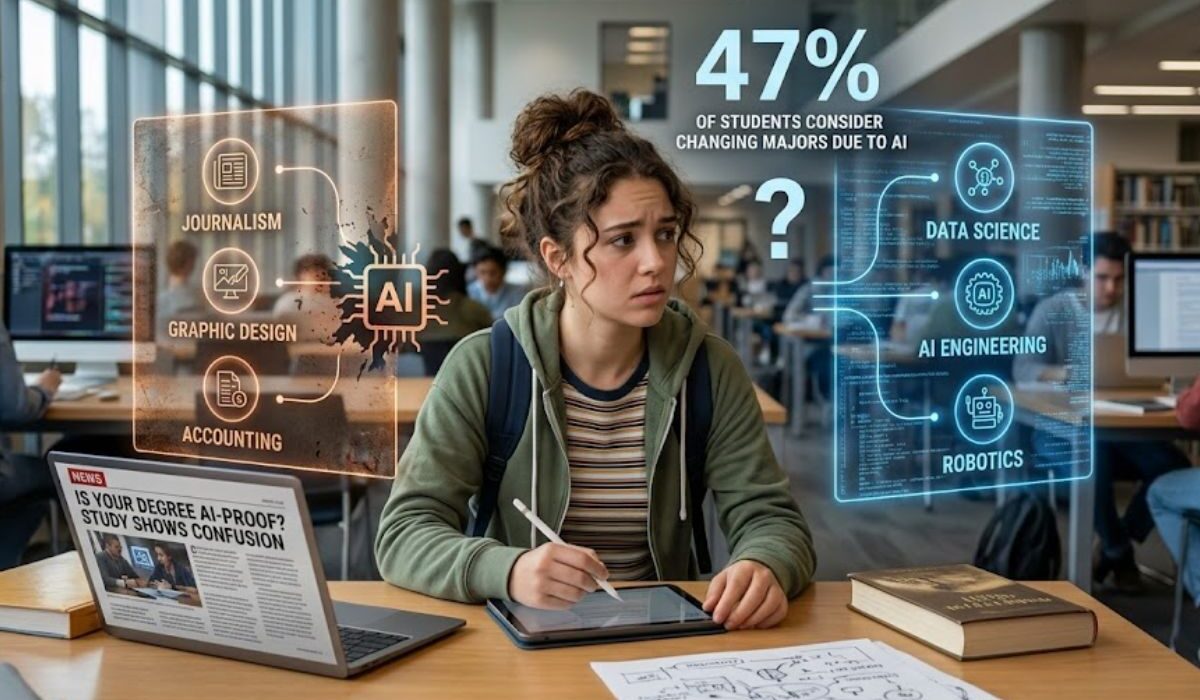
According to the Lumina Foundation-Gallup 2026 State of Higher Education Study, 47% of all college students have seriously considered changing their major because of AI’s potential impact on the job market.
Even more strikingly, roughly one in six students have already made the switch. When broken down by degree type, 13% of bachelor’s degree students and 19% of associate degree students report having officially changed their field of study due to AI concerns.
Why Are Students Switching Paths?
- Job Security Fears: Students are heavily concerned that the time and money invested in their degrees won’t pay off if AI wipes out their target industry. Their primary goal is finding a major that leads to viable, long-term career opportunities.
- The “Tech” Contradiction: There is massive confusion about which fields are actually “safe.” Students already in tech and vocational fields are the most likely to consider changing their majors—yet, paradoxically, those are the exact fields other students are rushing to switch into.
- Associate Degrees See More Movement: Associate degree students are switching at higher rates than bachelor’s students, likely because their credentials are more directly tied to immediate workforce needs.
Colleges Are Falling Behind
While many students are enrolling in degree programs specifically to learn AI skills and prepare for technological shifts, they often feel unsupported. AI policies vary wildly from campus to campus, and 29% of students say their school is not adequately preparing them to use AI in the real world. Consequently, students are making high-stakes decisions about their futures without clear guidance from their institutions.
The Best Defense:
“Durable Skills” Courtney Brown, vice president of impact and planning at the Lumina Foundation, points out that no one truly knows exactly what AI will do to the job market. Because of this, she stresses that the best defense is focusing on the “durable skills” that higher education provides.
Regardless of what major you choose, skills like communication, critical thinking, teamwork, and complex problem-solving remain irreplaceable. As technology continues to evolve, the ability to continually adapt, upskill, and reskill will be the most valuable asset a graduate can have.