


 By
By Artificial intelligence has swiftly transitioned from a futuristic concept to a daily workplace necessity. Across industries, employers are prioritizing AI proficiency as a critical skill—often placing it at the top of their hiring and promotion criteria.
Yet, beneath this wave of innovation lies a persistent imbalance:
- Women are actively using AI tools.
- However, they are less recognized for doing so.
- This disparity mirrors long-standing workplace biases—only now, it’s unfolding in a digital frontier.
Why AI Skills Are the New Career Currency
AI is no longer optional—it is foundational.

Key Reasons AI Matters Today:
- Productivity Boost: Automates repetitive tasks and enhances efficiency
- Decision-Making Power: Provides data-driven insights
- Creative Expansion: Assists in writing, design, and ideation
- Competitive Advantage: Differentiates employees in performance evaluations
What Employers Are Looking For:
- Initiative in adopting AI tools
- Ability to integrate AI into workflows
- Continuous learning and adaptability
Bottom Line:
Employees recognized for AI usage are more likely to advance.
The Data Behind the Gender Gap
Recent survey findings highlight subtle yet impactful differences.
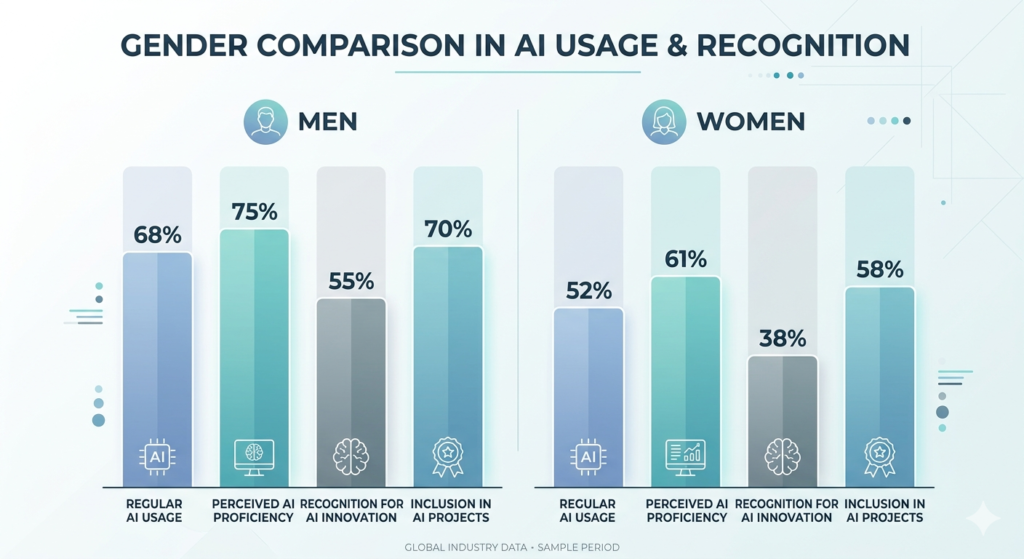
AI Usage Rates:
- Men using AI at work: 78%
- Women using AI at work: 73%
Recognition for AI Use:
- Men praised for AI efforts: 27%
- Women praised for AI efforts: 18%
Managerial Encouragement:
- Men encouraged to use AI: 37%
- Women encouraged to use AI: 30%
Why These Small Gaps Matter
At first glance, these differences may appear minor—but they compound over time.
Recognition Influences:
- Performance evaluations
- Salary increases
- Promotion opportunities
- Leadership visibility
Long-Term Impact:
- Men gain reputational advantages
- Women face slower career progression
- Workplace inequality widens
The Role of Workplace Bias
These disparities are not new—they are rooted in systemic patterns.

Common Bias Trends:
- Men are rewarded for potential and initiative
- Women are judged on proven outcomes
- Men are praised for effort
- Women are more frequently criticized
In the Context of AI:
- Men experimenting with AI = innovative
- Women doing the same = overlooked or questioned
The Encouragement Gap
Recognition is only part of the equation—encouragement matters just as much.
Why Encouragement Is Critical:
- Builds confidence
- Promotes experimentation
- Drives skill development
Current Reality:
- Men receive more guidance and support from managers
- Women receive less reinforcement, leading to hesitation
Result:
- Unequal growth in AI expertise
- Missed opportunities for women
The Perception Problem in Technical Roles
Bias becomes even more pronounced in technical fields.
Research Insights:
- Women using AI are sometimes viewed as less competent
- Men using AI are seen as strategic and efficient
Double Standard:
- AI use by men = skill enhancement
- AI use by women = perceived dependency
Mentorship and Feedback Gaps
Another critical issue is unequal access to support systems.
Key Challenges for Women:
- Less mentorship in technical growth
- Feedback focused on personality, not performance
- Fewer opportunities for skill-building conversations
Why This Matters:
- Mentorship accelerates learning
- Feedback shapes confidence and direction
- Lack of both limits advancement
The Compounding Effect Over Time
Small differences don’t stay small.
How the Cycle Builds:
- Less recognition
- Fewer opportunities
- Slower career progression
- Reduced leadership representation
Outcome:
- Gender gaps in pay and promotions widen
- Inequality becomes self-reinforcing
Organizational Consequences
This is not just a gender issue—it’s a business risk.
What Companies Lose:
- Untapped talent
- Diverse perspectives
- Innovation potential
Why Diversity Matters:
- Improves problem-solving
- Enhances creativity
- Strengthens decision-making
How Organizations Can Close the Gap
Addressing this issue requires deliberate action.
Steps Leaders Can Take:
- Ensure Equal Recognition
- Acknowledge contributions consistently
- Track recognition patterns
- Encourage AI Adoption for All
- Provide equal access to tools and training
- Actively support experimentation
- Revise Performance Evaluations
- Value effort and learning—not just outcomes
- Reduce bias in feedback
- Expand Mentorship Opportunities
- Pair employees with experienced mentors
- Focus on technical growth
- Promote Inclusive Culture
- Reward curiosity
- Normalize trial and error
Rethinking “Lean In” in the AI Era
The traditional advice for women has been to “lean in.” In today’s landscape, that advice evolves.
What “Leaning In” Means Now:
- Actively learning AI tools
- Experimenting without fear of failure
- Making contributions visible
But It’s Not Just on Women:
- Organizations must create supportive environments
- Leaders must ensure fair recognition
The Future of Work: Who Gets Ahead?
AI is shaping the next generation of leaders.
Those Who Will Lead:
- Early adopters of AI
- Recognized innovators
- Employees with visible impact
The Risk:
- Women being left behind despite equal effort
Conclusion: Small Gaps, Big Consequences
The recognition gap in AI use may seem minor today—but its long-term effects are significant.
Key Takeaways:
- Women are using AI—but not equally recognized
- Bias continues to shape workplace outcomes
- Recognition directly impacts career growth
Final Thought:
- Addressing these gaps now is critical
- The future of work must be equitable, inclusive, and fair
In the age of AI, recognition is power—and it must be shared equally.